Gravimetric Blenders for Every Molding and Extrusion Line
Color Weighed. Regrind Used. Ratios Held.
Gravimetric blenders for injection molders, extrusion processors, blow molders and compounders. Every component is weighed as it is dispensed, so the color, regrind and additive ratios stay where the recipe sets them.
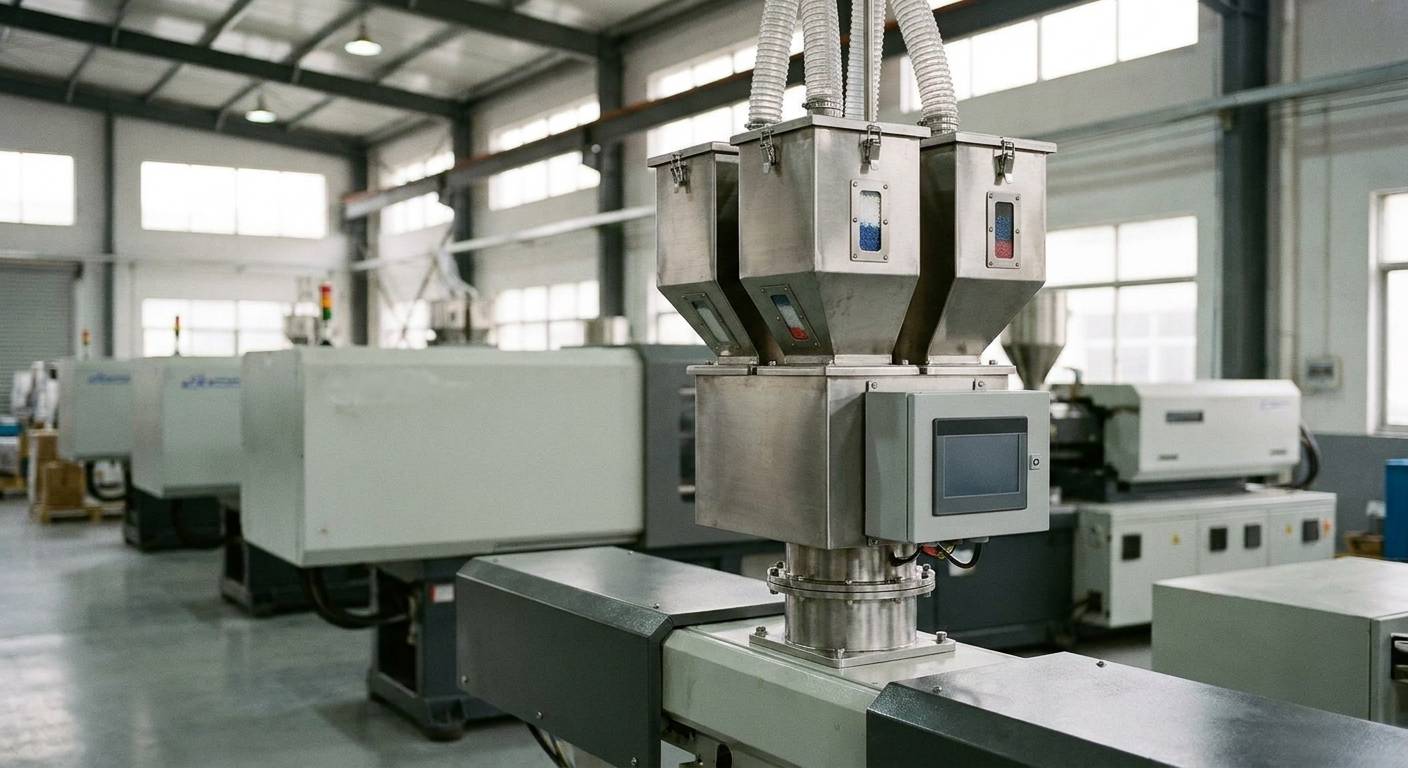
How a gravimetric blender works
A volumetric doser meters by time and trusts that every second delivers the same amount. A gravimetric blender weighs every dose. If one comes out light or heavy, the controller corrects the next one from what it measured.
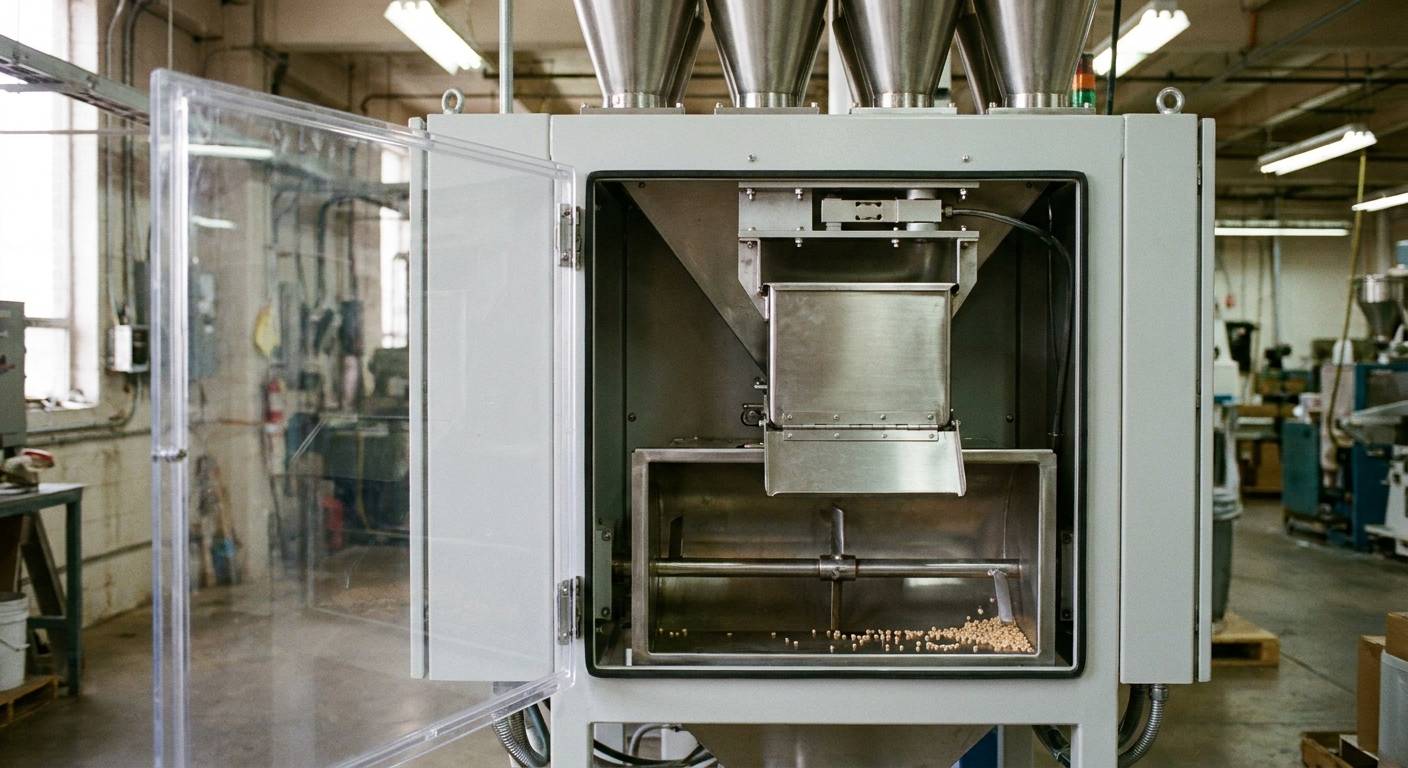
The weighing package has three parts: the feeders that dispense each ingredient, the weigh bin that catches and weighs it, and the controller that runs both. Below is a batch blender, which weighs and mixes one batch at a time.
- Supply hoppers
- One compartment per component: natural resin, regrind, each color and each additive. Blenders are built for anything from two components to twelve.
- Dispense valves
- Main components drop through pneumatic slide gates. Plunger valves, discs, pinch valves and vee ports do the same job on other designs.
- Small-ingredient feeders
- Color and additives are dosed in grams, so they go through a smaller valve, a flow restrictor or a screw feeder. One extra turn of a screw flight is enough to miss the target.
- Weigh bin
- Catches each component in turn and weighs it. Every ingredient of a batch is weighed in the same bin, so the batch weight sets the resolution.
- Load cells
- Hold the weigh bin and report its weight. The controller has to filter out the machine's normal vibration, and nothing such as a hose or cable may touch the weighing system.
- Mixing chamber and mixer
- The weigh bin dumps each batch into the mixing chamber, where the mixer blends it. The blend leaves through a shut-off or flow-control valve into the feed throat.
- Level sensor
- Watches the blend in the mixing chamber so the next batch is made as the machine draws the last one down. Dust and fines can fool it, which is why some blenders blow it clean with air.
- Controller
- Holds the recipe as percentages, works out the target weight of every component, and corrects each dispense from the weight it measured.
One batch, start to finish
The weigh bin in the drawing holds one batch in the order it was dosed. This is the cycle that put it there, and it repeats for as long as the machine runs.
Recipe
Each component is entered as a percentage. The controller turns the recipe into target weights for one batch.
Main material
The main material, usually natural resin, is dispensed into the weigh bin and its actual weight is read.
The rest, by ratio
Color and additives are metered one at a time against the weight of natural resin that actually landed.
Dump and mix
The weigh bin opens into the mixing chamber and the mixer blends the new batch.
Feed the throat
The machine draws blend from the chamber. When the level drops, the blender makes the next batch.
Batch, continuous or volumetric
Batch and continuous blenders both weigh; they differ in when they weigh and how they mix. Volumetric dosing is here for comparison, because it is the method weighing blenders are measured against.
| Type | How it doses | Good for | Watch for |
|---|---|---|---|
| Batchweigh-scale | How it doses: Components are dispensed one after another into a single weigh bin, weighed, then dumped into a mixing chamber. | Good for: Injection molding and extrusion, many components, and low throughputs, where a batch blender keeps its accuracy. | Watch for: Resolution is limited to the batch weight, so a few grams matter on a small batch. A mechanical mixer can separate powders and light regrind from pellets. |
| Continuousloss-in-weight | How it doses: Each component has its own feeder on its own scale. All of them meter at once, at a controlled rate, into a cascade mixer. | Good for: Extrusion and compounding lines, ingredients below about 4% of the blend, and dissimilar materials such as powder and light regrind. | Watch for: Feeder accuracy can fall away at metering rates below about 5 kg/hr (11 lb/hr). Each feeder is its own scale, usually on an open frame, and more exposed to knocks and interference. |
| Volumetricfor comparison | How it doses: Meters by time, on the assumption that a hand-calibrated device delivers the same volume every second. Nothing is weighed. | Good for: Simple jobs on one material whose bulk density stays put, once someone has calibrated it for that material. | Watch for: Changes in bulk density go unnoticed, so color and additives are usually set above the minimum to be safe. There is no record of what was actually used. |
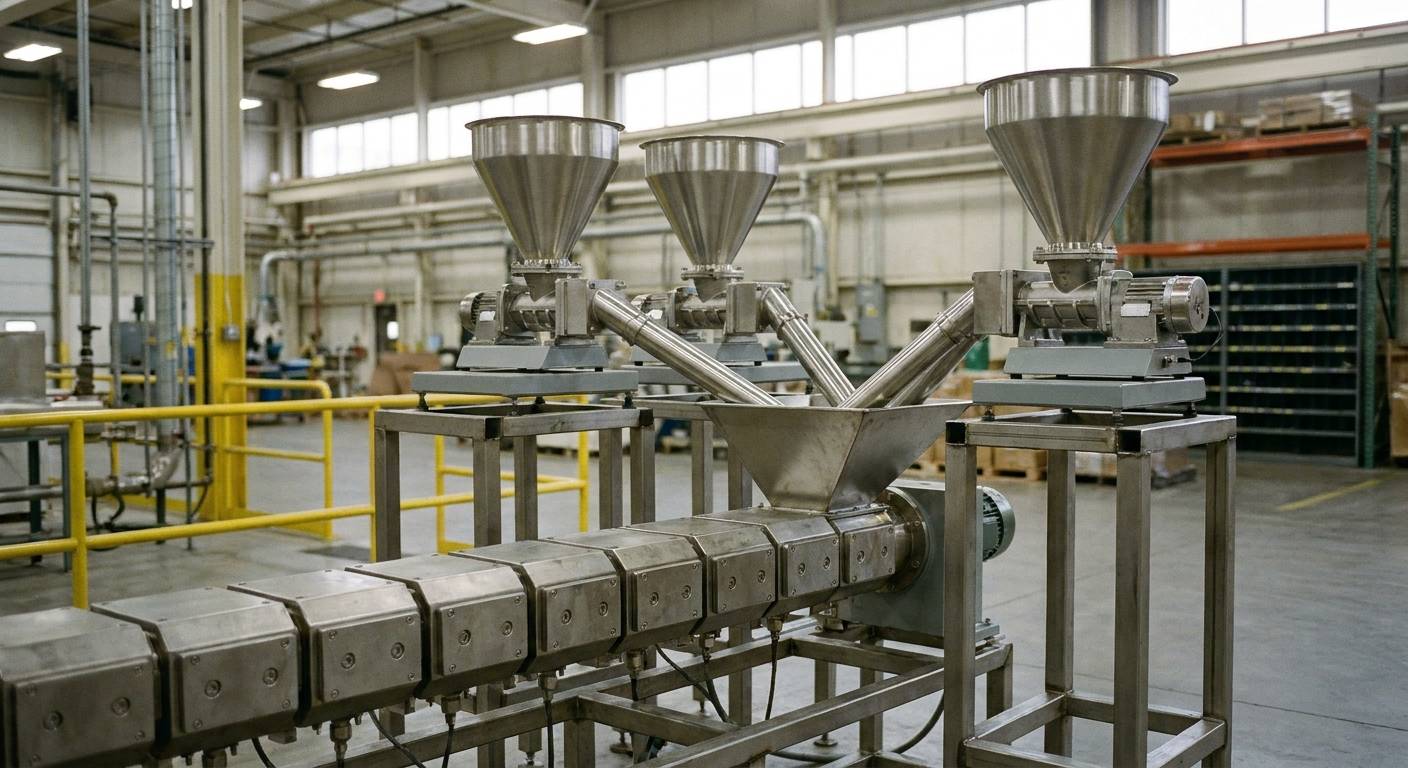
How loss-in-weight feeding works
A loss-in-weight feeder sits on a scale and measures how fast its weight falls as it doses. When the bulk density of the material changes, the controller sees it and changes the metering speed to hold the set rate.
On extrusion lines the same idea can control the extruder. A weigh hopper on the throat measures material use, and with a line-speed encoder at the haul-off, some systems trim screw speed to hold weight per length.
What goes into the blend
Most blends are a main resin, some regrind, a color and an additive or two. Each one behaves differently in a hopper, and the small ingredients, color and additives, are the expensive ones.

- Natural resin
- Usually the largest share of the blend and the material the others are proportioned to. In many blenders it goes in first, and everything else is proportioned to its measured weight.
- Regrind
- Flakes and irregular pieces pack and flow differently from pellets and tend to bridge in a hopper. Bridge breakers or other mechanical agitation keep them moving, because the dose is only accurate when material reaches the feeder steadily.
- Color masterbatch
- Dosed at a few percent, so small errors are expensive. At 4% of a 1 kg batch the target is 40 grams, and a gram of color is about 40 pellets.
- Additives
- UV stabilizers, inhibitors, strengtheners and the like. Some can be overfed to cover dosing error, at a cost. Others must stay inside a narrow window, which is where weighing pays for itself.
- Dried, hygroscopic resin
- Dried material can pick up moisture again while it waits in the blender. Blenders can be blanketed with dry air to stop it. The blanket only has to prevent moisture pickup, so it does not need dryer-grade air.
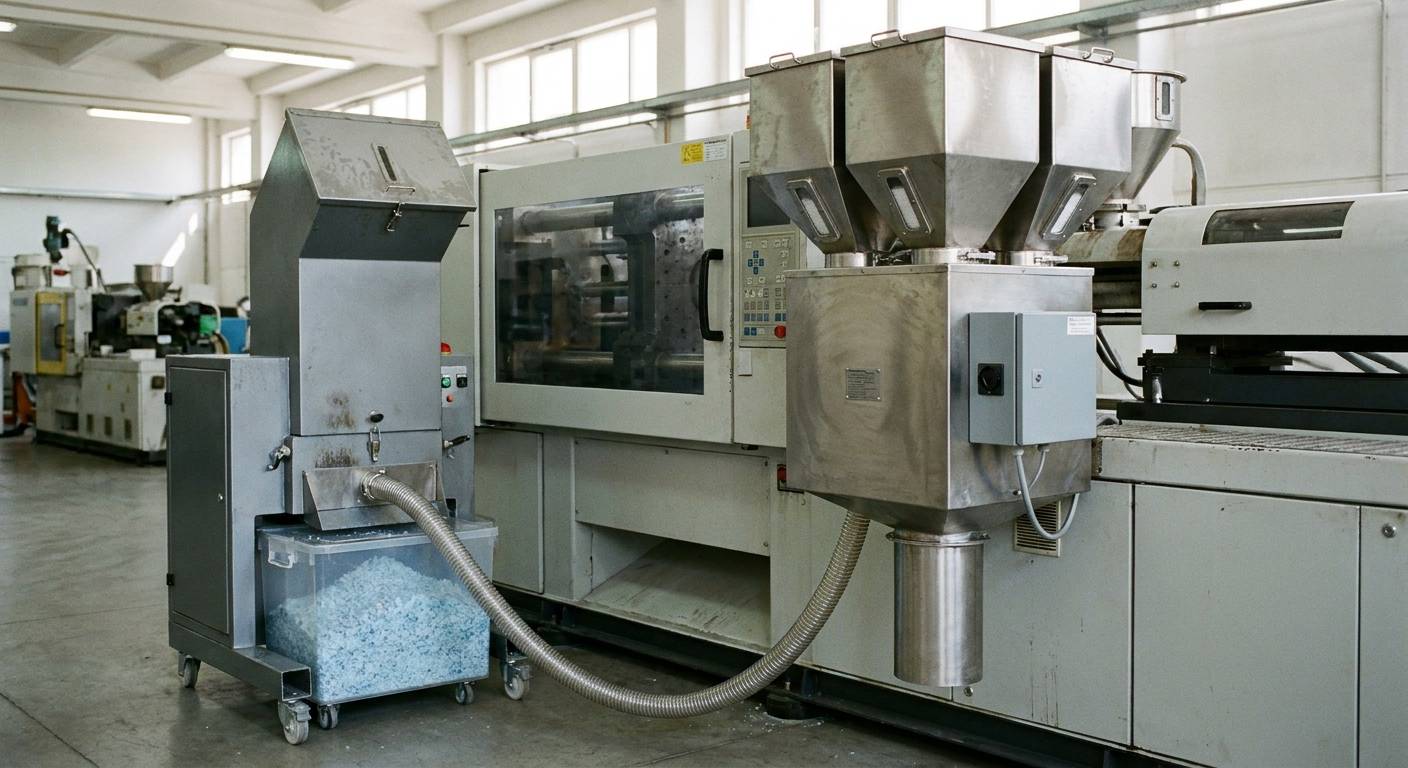
How to size a gravimetric blender
Start from the machine and the recipe. Blenders are built for two to twelve components and from laboratory units of about 10 lb/hr to central blenders rated up to 12,000 lb/hr.
| Size | What decides it | What to ask |
|---|---|---|
| Throughput | What decides it: The most material the machine can use in an hour, in lb/hr or kg/hr, plus margin. Datasheet rates are usually stated for free-flowing pellets of similar bulk density, which is the best case. | What to ask: What rate will it hold with my resin, my share of regrind and my bulk densities? |
| Components | What decides it: Natural resin, regrind, each color and each additive need their own hopper and feeder. Count the ones you run now and the ones you expect to add. | What to ask: How many positions does it have, and can one be added later? |
| Smallest ingredient | What decides it: Ingredients at a percent or two need a small valve, a restrictor or a screw feeder. Below about 4% of the blend, a continuous blender's separate scale for each ingredient starts to pay off. | What to ask: How is my smallest ingredient metered, and what is its error in grams per batch? |
| Batch size | What decides it: A fixed error in grams is a bigger share of a small batch. A slide gate good to 2.5 grams is 0.25% of a 1 kg batch and 0.014% of an 18 kg batch. | What to ask: What batch size will it run on my machine, and how many batches an hour? |
| Material form | What decides it: Pellets flow. Flake regrind, powders and wood flour can bridge and need feed devices made for them. | What to ask: Which feed device do you fit for my regrind or powder, and can I test it? |
| Mounting | What decides it: On the machine throat, or remote on a stand feeding one or more machines. Off the throat, an automatic shut-off valve goes below the mixer. | What to ask: How is the blend kept from separating between the blender and the machine? |
Accuracy and material savings
Suppliers state accuracy in different ways, so compare claims on the same basis. Most of the saving comes from the smallest and most expensive ingredients.
- Ask for the error in grams
- There is no accepted standard for stating blender accuracy. Claims are made per ingredient, per batch or batch to batch. Ask for the average error in grams per batch and compare it with the batch size.
- A few pellets matter
- 4% color in a 1 kg batch is 40 grams. Holding that to ±0.5% of the ingredient means ±0.2 grams, about eight pellets.
- Check what reaches the machine
- The load cells keep the blender consistent from batch to batch. To prove what the machine is getting, sample the delivered blend and weigh it on an accurate scale.
- Where the savings come from
- With volumetric dosing, color and additives are set above the minimum to cover dosing error. Weighing lets that margin shrink. One published payback example set a volumetric blender 3% above the minimum, a batch blender 1% and a continuous blender 0.5%, and found both weighing blenders paid for themselves in well under a year on additives alone.
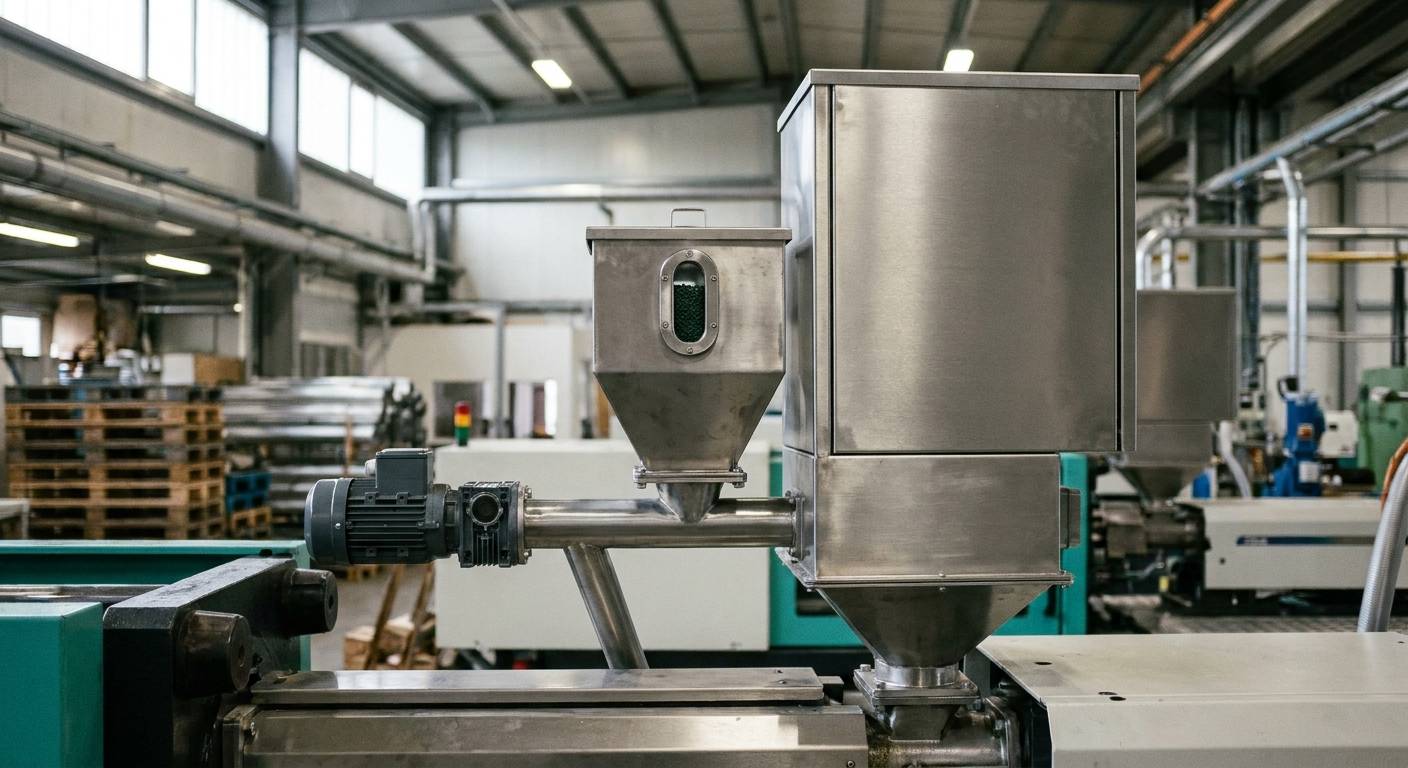
On molding machines, extruders and blow molders
On every machine the blender's job is to deliver the set ratio to the throat. Mounting, materials and the process around it are what differ.
Injection molding
The first gravimetric blenders were built to sit on injection presses, weighing color, regrind and natural resin on the throat of one machine. Plants with frequent color changes may blend remotely instead and convey finished batches to the presses.
Extrusion
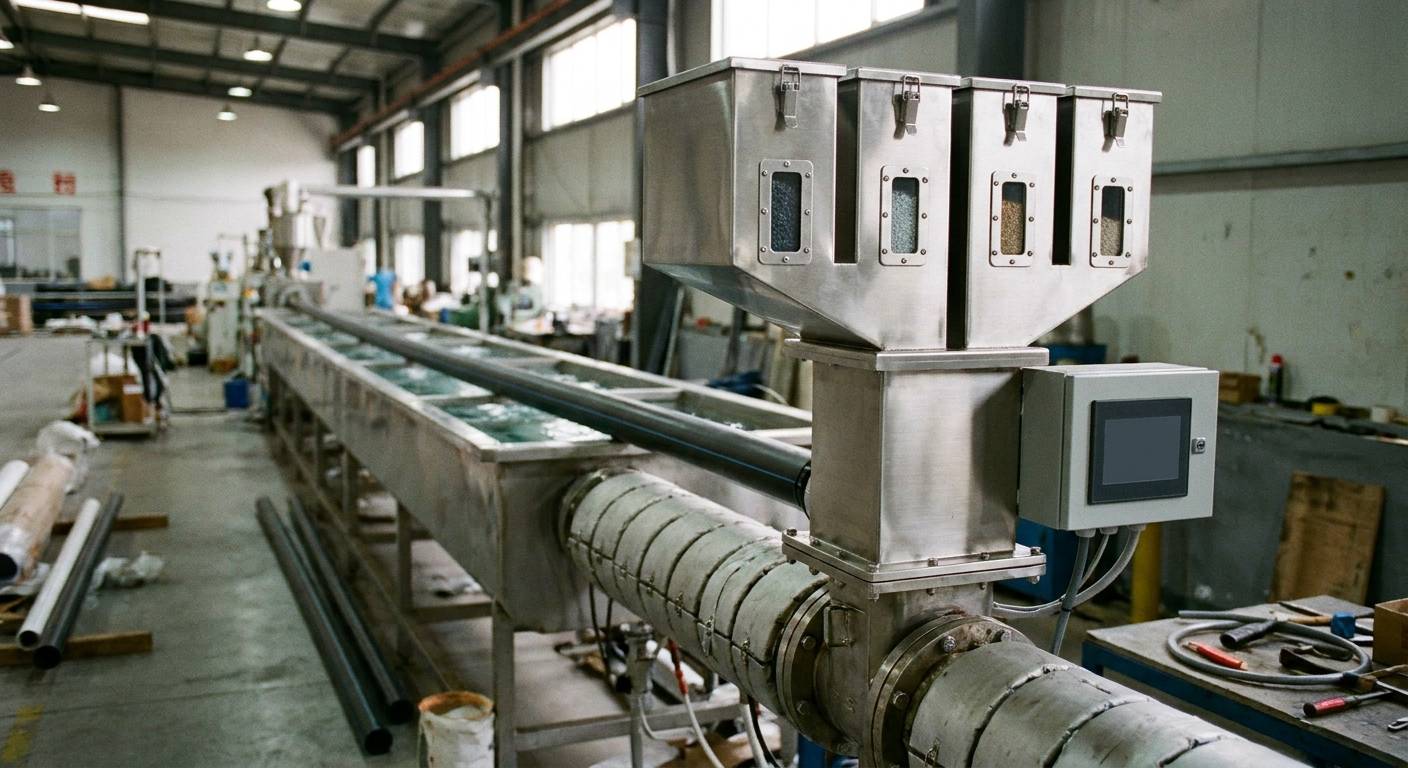
Film, sheet, pipe and profile lines run batch blenders on the throat or continuous loss-in-weight blending. With a line-speed encoder at the haul-off, some systems trim screw speed to hold weight per length.
Blow molding
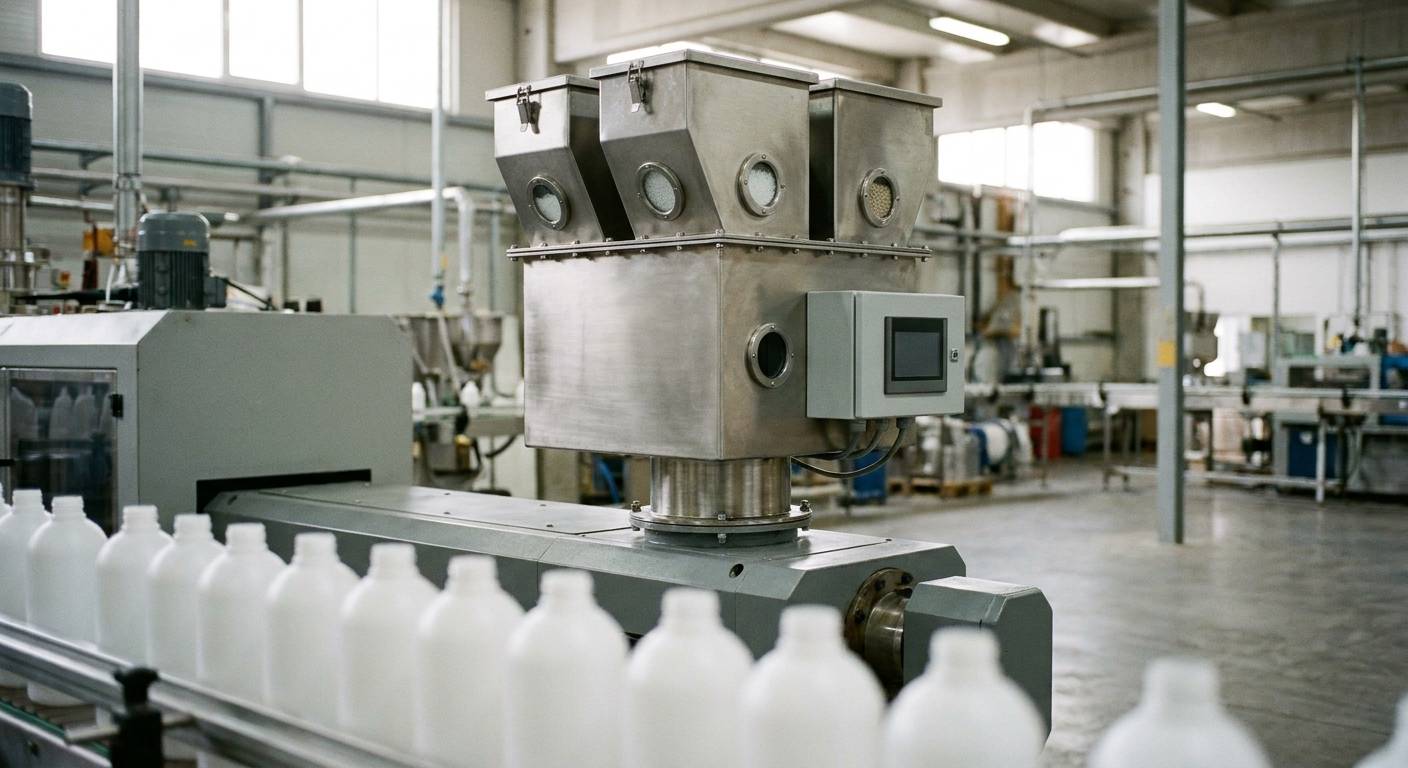
Extrusion blow molding trims flash from the parts, and that flash usually goes back into the machine as regrind, weighed in with the natural resin and color.
Compounding
Compounders feed twin-screw extruders through loss-in-weight feeders, each ingredient on its own scale, metered continuously into the same feed opening.
Controls, recipes and plant data
Because it weighs everything, a gravimetric blender has a record of what it used. Processors are increasingly asked to show how and when a product was made, and that record helps answer the question.
- Recipes
- Recipes and resin names are stored in the controller, so changing jobs means recalling a stored recipe instead of working out the weights again.
- Usage records
- The controller counts what it dispenses: batches, weight by hopper and weight in total. That is the material record a volumetric doser cannot give you.
- Alarms
- Level alarms on the supply hoppers warn before a component runs out, instead of after a run of parts made without it.
- Connecting it
- Ethernet links to the machine or a supervisor's screen and USB export are common. Ask which protocol the controller offers, for example Modbus TCP or OPC UA, and check it against your MES before you buy.
Keeping a blender accurate
Accuracy depends on calibrated load cells, clean dry air and gates that open and close properly. The maker's manual sets the details for your model; these are the checks to look for in it.
Every shift
- Look the blender over for loose parts. Locking devices are not always put back correctly after cleaning, and machine vibration loosens parts over time.
- Watch the dispense gates open and close. Sticking or slamming cylinders point to dirty air.
- Keep material hoses, air lines and cables clear of the weighing system.
Calibration
- Calibrate each load cell with a weight of known value: a zero-weight calibration, then a full-weight calibration, following the maker's procedure.
- It takes under five minutes and can usually be done without stopping the machine.
- Where accuracy or documentation is critical, check it once a shift or once a day against actual material use. Elsewhere, monthly may be enough.
Air, static and cleaning
- Supply clean, dry air at the maker's pressure. Filter it at the blender or, better, at the compressor.
- Ground conveying lines, the blender frame and the weigh hoppers. Static discharge is one of the most common causes of failure.
- For a color change, drain the hoppers, then remove the weigh bin and mixing chamber. A vacuum is often better than an air hose, which can lodge debris in critical parts.
- Book a yearly supplier visit for a tune-up and an operator refresher, and ask for written maintenance procedures.
Buying checklist
Take these to every supplier you talk to, and ask for a trial on your own materials before you compare prices.
- Rated throughput with your resin, regrind share and bulk densities, not the best-case datasheet figure
- Number of components now, and spare positions for later
- How the smallest ingredient is metered, and its error in grams per batch
- Batch or continuous, and the batch size on your machine
- Feed devices for flake regrind, powder or other hard-to-flow material
- Machine mount or remote, the shut-off valve, and how the blend is kept from separating
- The calibration procedure with test weights, and how long it takes
- Cleanout: drain ports, a removable weigh bin and mixing chamber, parts that come apart without tools
- Air supply pressure and filtration
- Recipe storage, usage reports, alarms, and the protocol for your MES
- A dry air blanket, if you blend dried hygroscopic resin
- A trial on your own resin and regrind, with the delivered blend sampled on a scale
- Written maintenance procedures, spare parts, training and a yearly service visit
Gravimetric blender questions
Information only. This guide is general and educational. It is not engineering or professional advice and does not replace the equipment maker's instructions. Check it before relying on it. Read the full disclaimer.
What is a gravimetric blender?
A gravimetric blender doses the materials that make up a plastic blend by weight. It sits on the feed throat of an injection molding machine, extruder or blow molder, or on a stand nearby, and meters natural resin, regrind, color masterbatch and additives in set proportions. Every dose is weighed, and the controller corrects the next one from what it measured.
How is it different from a volumetric feeder?
A volumetric feeder meters by time, on the assumption that a hand-calibrated device delivers the same volume every second. If the bulk density of the material changes, so does the weight it delivers, and nothing notices. A gravimetric blender weighs each dose, needs no set-up calibration for the recipe, and keeps a record of what it used.
Batch or continuous: which should I choose?
A batch blender weighs all the ingredients in one bin, one after another, and mixes each batch in a chamber. It suits injection molding and extrusion and keeps its accuracy at low throughputs. A continuous blender gives every ingredient its own loss-in-weight feeder and meters them all at once into a cascade mixer. It suits extrusion and compounding, ingredients below about 4% of the blend, and dissimilar materials such as powder and light regrind.
How accurate is a gravimetric blender?
It depends on the batch size, the feed device and the material, and there is no accepted standard for stating it. Suppliers quote accuracy per ingredient, per batch or batch to batch, so the numbers are hard to compare. Ask for the average error in grams per batch, compare it with the batch size, and test the blender on your own materials.
Can a gravimetric blender handle regrind?
Yes. Regrind is one of the most common components. Flakes and irregular pieces flow less freely than pellets and can bridge in a hopper, so ask for bridge breakers or a feed device suited to your regrind. Light regrind and powders can separate from pellets in a mechanical mixer, which is one reason some processors choose continuous blending for them.
Does a gravimetric blender pay for itself?
The saving usually comes from color and additives. With volumetric dosing they are set above the minimum to cover dosing error; weighing lets that margin shrink. One published payback example found batch and continuous blenders paid for themselves in well under a year against a volumetric blender, on additives alone. Run the numbers with your own materials and prices.
Should the blender sit on the machine or be remote?
Blenders have traditionally been mounted on the machine throat. Equipment stack-ups, frequent color changes and access platforms lead some plants to blend remotely instead and convey finished batches to one or more machines. Remote blending needs an automatic shut-off valve below the mixer and a way to keep the blend from separating on the way to the machine.
How often should the load cells be calibrated?
Calibrate each load cell with a weight of known value, zero first and then full weight, following the maker's procedure. It takes under five minutes and can usually be done without stopping the machine. Where accuracy or documentation is critical, check it once a shift or once a day; in less critical work, monthly may be enough.
What size blender do I need?
Start from the most material your machine can use in an hour, then add margin, because datasheet rates are stated for free-flowing pellets of similar bulk density. Count your components, including any you expect to add, and look at your smallest ingredient, since that decides the feed device. Blenders range from small laboratory units to central blenders rated at thousands of pounds an hour.
Will dried resin pick up moisture in the blender?
It can, especially hygroscopic resins and blends with regrind. Blenders can be blanketed with dry air to stop moisture regain while the material waits. The blanket does not need dryer-grade air: a dry-air generator that lowers the ambient dew point is usually enough.
Request pricing on gravimetric blenders
Tell us what you run, how many components are in the recipe and how much material the machine uses in an hour. You will get a reply, usually within one business day.
- Batch (weigh-scale) blenders for molding and extrusion
- Continuous loss-in-weight blending
- Color and additive feeders
- Remote and central blending systems